Showing posts with label Shortboarders. Show all posts

Sunday, June 2, 2013

Localism- Taking Words To Heart

Everybody knows that as soon as someone tells someone else about their surf spot that next thing you know a million people are there and it gets packed and it turns that once hidden gem into a lump of crap. That might not always be the case, but I think its a fear that all surfers have. Even I have had a few lessons from the locals and I took those words to heart. I don't want my favorite spots to get turn into a mess either and I will also work on sharing waves.


This is what all locals fear:

Surfers were run over and cut each other off as many riders go for the same wave. Others were run over as they tried to paddle out. 


The more people that paddle out in the same surf beak equates to a higher the risk of injury. It gets even more dangerous as the size of with wave gets bigger.  I personally know someone who lost an eye in a surf accident after getting his lease tangle up with another guy then a set wave hit him and the other guys board took out his eye- for life. I know another guy who broke his neck paddling out on a big day and was brought back to life on the beach (by my friend and is still surfing today). If you want to see some nasty things that can happen do a google search forSurf Accident.  

Please give this some thought- Do you really want to cause harm to yourself or to others by surfing in crowded areas? Do you really want to cause harm to yourself or to others on purpose by “protecting” your local surf spot?


Pascal Dattler suffered severe head trauma at on Friday when hit in the head by another surfer's board at a crowded surf spotPhoto: Tweed Daily News

Read more: http://www.brisbanetimes.com.au/sport/surf-helmet-call-after-grommets-skull-crushed-20100113-m5eh.html#ixzz1rfBxxawQ


There is also the risk that the beach will be too crowded with people and swimmers and then become “black balled” (No surfing allowed)…

I probably sound a bit like a local and to be truthful I am a South Bay local. I grew up surfing here and don't have any plans to leave- ever. Localism has gotten a bad reputation, and I’ll admit that some of that is well deserved as publicized in Rough Waves, Tougher Beaches Published: January 22, 2009http://www.nytimes.com/2009/01/23/sports/othersports/23surfing.html?_r=3&pagewanted=1&sq=wolfpak&st=cse&scp=1

Marco Garcia for The New York Times
Kala Alexander, the Wolfpak's enforcer and most notorious member, in May 2008.
By MATT HIGGINS
SUNSET BEACH, Hawaii — They are known as the Wolfpak or simply “the boys.” They use fear and their fists to command respect in the surf along the North Shore of Oahu, a seven-mile stretch of some of the world’s most renowned waves. At the celebrated Banzai Pipeline, they determine which waves go to whom, and punish those who breach their code of respect for local residents and the waves.
Localism has two major divisions; Local #1 (Non-violent) people who go to the same spot all the time and know how the waves break and know the regular people that hang out and surf there. Local #2 (Violent) same Local wave knowledge and they don’t want others (non-locals) to go to that spot and are willing to intimate, beat up, vandalize or use other scare tactics to keep outsider (non-locals) away.
I fall into the first division of localism (non-violent). I’m a peace keeper, I’m out to keep people safe and out of trouble. I’ve helped rescue a few new surfers here and there. In some cases that meant I had to leave to keep myself safe and out of trouble too.

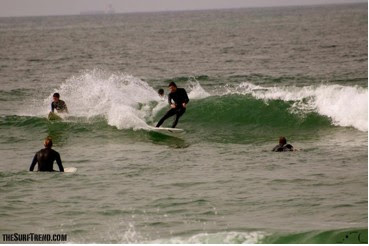
Let’s face it the beaches with the biggest parking lots will obviously have the most surfers out in the water, like El Porto in Manhattan Beach (CA).  Porto also consistently picks up the most swell in the South Bay area.  It also has some of the best surfers battling it out for prime take-off positioning. Short boarders, long boarders, Sup’ers, knee boarders, body boarders, body surfers and the occasional swimmer and converging in the water in front of the paved metered parking lot.


 It’s the same scenario at Manhattan Pier, Hermosa Pier, and the Avenues in Redondo. Easy beach usually access means more people. A longer walk will change things only a little bit. The Cove (Malaga Cove / Bluff Cove) in PV (Palos Verdes) is a little less crowded with Sup’ers, knee boarders, body boarders, body surfers and swimmers. Its watercraft diversity has thinned for two reasons; 1) it’s a long half mile hike from the cliff down to the rocky shore line below and 2) some of the Locals (local #2’s) have been known to make things uncomfortable for non-locals (sometimes verbally sometimes physically). There are lots for really fun surf spots between PV and El Porto. I encourage you to try surfing different spots, and ride different styles of boards. It may give you a new perspective and appreciation for your home breaks.

I have A Modest Proposal when it comes to surf exploration. Become a local (#1) and if you can’t become a local (#1) then please try see the beach or surf spot like you are a local. Here is a list of a few things that have helped me stay under the radar when I’m surfing new spots.

  • ·       Locals want to keep their beach, ocean, neighborhood clean. This is your opportunity to win a few points by picking up any trash you see laying around. Try not to make a big deal out of and you’ll get even more points. By picking up trash it shows the locals that you care about the area (and you might pass as a local yourself). 
  • ·       Don’t bring a crowd with you. It’s ok to bring a friend but don’t bring lots of friends. If you want to bring lots of friends then you should surf at a spot with lots of metered parking.
  • ·       Paddle around the impact zone whenever possible. The impact zone is where the waves are breaking and where most of the other surfers are going to be taking off on waves.
  • ·       Share waves. That means don’t take off on every wave that comes near you. Let a few go by for others to enjoy. These days it usually a one person per wave sport and there is etiquette involved. Closest person to the peak get the wave, don’t drop in on someone else that has already caught the wave. Sometime there's a line up where you just wait your turn.  In the early days of surfing people shared waves all the time and by shared I mean rode the same wave together. There was a more the merrier attitude from the early 1900’s thru the 1940’s. Something changed somewhere between the 1950’s and 1970’s and it became a one person per wave mentality.
  • ·       If you do get snaked (someone drops in front of you on a wave) try not to let it ruin your day. There will always be more waves. If the person who snaked you is a newbie give them some encouragement and some safety tips (like a good local #1) they might not know all the rules of surfing etiquette. Remember all surfers started out not knowing everything. If they are not a newbie then just be careful, that person might just be looking for a reason to fight (and you might be out numbered). If it looks like it might get ugly - leave. There is no shame in walking (or paddling) away from a fight. Plus who wants to surf a spot where it has a crappy vibe. There are waves all over the place. There could be waves breaking just a few yards farther away that might have a happier vibe.
  • ·       If you’re still a beginner don’t go off the beaten path yet.  Stick to the areas near operating lifeguard towers and if you can stay a little farther left or right from the main breaks. As a beginner you are at the highest risk of getting hurt by your own board. It can take some time just to learn how and when to paddle out. Then you have to figure out how to stand up on your board and that’s where the addiction to the stoke really starts.
  •      Be safe and have fun.

GERRY LOPEZ--THE ALOHA SPIRIT OF SURFING


Thursday, April 12, 2012

What do you mean you never heard of the SouthBay....

Well if you haven't heard of the SouthBay then here's a few videos to help bring you up to speed.... (I'll add more to this later...)


80's Surf Stars of the South Bay, Chris Frohoff, 

Ted Robinson, Kelly Gibson, 02-10-88


(El Porto, 1988)

Redondo Breakwall 02-05-91 

Frohoff, Robinson, Gibson, Cukr, Martinez, Frosty, 

Shy


(Break Wall 1991)

Somewhere in the South Bay 12.8.07

(Burn-Out 2007)


Haggerty's Surfing 02-04-93

(Haggs 1993)

Surfing in Palos Verdes 1979-1982

(PV 1979-82)

Surfing the Palos Verdes Coast In Los Angeles, California

(PV 2010)

Lunada Bay Surf - Winter 2012

(Lunada 2012)

Tuesday, April 10, 2012

Evicting the entitlement monster is Impossible – Localism


I tend to keep a low profile when I paddle out to surf. I look calm and comfortable as I paddle out, like all locals do, but I’m not a local at all the places I surf. Like most surfers I like the least amount of people out in the water and those good places are getting harder others to find. Actually it’s pretty easy to find an empty break in the South Bay, there are lots of them but some are monitored and enforced by locals so be careful.


 It helps if you know how the different beaches break on high and low tides so you can pick which direction to go (north or South). I’m not going to tell you where my favorite South Bay secret spots are- that wouldn’t be any fun. Everybody knows that as soon as someone tells someone else about their secret surf spot that next thing you know a million people are there and it gets packed and it turns that once hidden gem into a lump of crap.  

This is what all locals fear:


I hear it all the time:

"This guy thought he owned the waves and he kept dropping in on me so I pushed him off," he said. "When he came up he came at me and it was on." 

I've been surfing here for a long time and I've never seen so many people in the water. There are hundreds and hundreds of people and not enough waves to go around so I reckon it'll get ugly," he said.

Surfers were run over and cut each other off as many riders go for the same wave. Others were run over as they tried to paddle out.

"It's insane, you have to psych yourself up just to paddle out because you know, sooner or later, someone's going to have a go at you."

The more people that paddle out in the same surf beak equates to a higher the risk of injury. It gets even more dangerous as the size of with wave gets bigger.  I personally know someone who lost an eye in a surf accident after getting his lease tangle up with another guy then a set wave hit him and the other guys board took out his eye- for life. I know another guy who broke his neck paddling out on a big day and was brought back to life on the beach (and is still surfing today). If you want to see some nasty things that can happen do a google search for Surf Accident.  

Please give this some thought- Do you really want to cause harm to yourself or to others by surfing in crowded areas? Do you really want to cause harm to yourself or to others on purpose by “protecting” your local surf spot?


Pascal Dattler suffered severe head trauma at on Friday when hit in the head by another surfer's board at a crowded surf spot. Photo: Tweed Daily News

Read more: http://www.brisbanetimes.com.au/sport/surf-helmet-call-after-grommets-skull-crushed-20100113-m5eh.html#ixzz1rfBxxawQ


There is also the risk that the beach will be too crowded with people and swimmers and then become “black balled” (No surfing allowed)…
I probably sound a bit like a local and to be truthful I am a South Bay local. Localism has gotten a bad reputation, and I’ll admit that some of that is well deserved as publicized in Rough Waves, Tougher Beaches Published: January 22, 2009 http://www.nytimes.com/2009/01/23/sports/othersports/23surfing.html?_r=3&pagewanted=1&sq=wolfpak&st=cse&scp=1

Marco Garcia for The New York Times
Kala Alexander, the Wolfpak's enforcer and most notorious member, in May 2008.
By MATT HIGGINS
SUNSET BEACH, Hawaii — They are known as the Wolfpak or simply “the boys.” They use fear and their fists to command respect in the surf along the North Shore of Oahu, a seven-mile stretch of some of the world’s most renowned waves. At the celebrated Banzai Pipeline, they determine which waves go to whom, and punish those who breach their code of respect for local residents and the waves.
Localism has two major divisions; Local #1 (Non-violent) people who go to the same spot all the time and know how the waves break and know the regular people that hang out and surf there. Local #2 (Violent) same Local wave knowledge and they don’t want others (non-locals) to go to that spot and are willing to intimate, beat up, vandalize or use other scare tactics to keep outsider (non-locals) away.
I fall into the first division of localism (non-violent). I’m a peace keeper, I’m out to keep people safe and out of trouble. I’ve helped rescue a few new surfers here and there. In some cases that meant I had to leave to keep myself safe and out of trouble too.

Let’s face it the beaches with the biggest parking lots will obviously have the most surfers out in the water, like El Porto in Manhattan Beach (CA).  Porto also consistently picks up the most swell in the South Bay area.  It also has some of the best surfers battling it out for prime take-off positioning. Short boarders, long boarders, Sup’ers, knee boarders, body boarders, body surfers and the occasional swimmer and converging in the water in front of the paved metered parking lot.


 It’s the same scenario at Manhattan Pier, Hermosa Pier, and the Avenues in Redondo. Easy beach usually access means more people. A longer walk will change things only a little bit. The Cove (Malaga Cove / Bluff Cove) in PV (Palos Verdes) is a little less crowded with Sup’ers, knee boarders, body boarders, body surfers and swimmers. Its watercraft diversity has thinned for two reasons; 1) it’s a long half mile hike from the cliff down to the rocky shore line below and 2) some of the Locals (local #2’s) have been known to make things uncomfortable for non-locals (sometimes verbally sometimes physically). There are lots for really fun surf spots between PV and El Porto. I encourage you to try surfing different spots, and ride different styles of boards. It may give you a new perspective and appreciation for your home breaks.

I have A Modest Proposal when it comes to surf exploration. Become a local (#1) and if you can’t become a local (#1) then please try see the beach or surf spot like you are a local. Here is a list of a few things that have helped me stay under the radar when I’m surfing new spots.

  • ·       Locals want to keep their beach, ocean, neighborhood clean. This is your opportunity to win a few points by picking up any trash you see laying around. Try not to make a big deal out of and you’ll get even more points. By picking up trash it shows the locals that you care about the area (and you might pass as a local yourself). 
  • ·       Don’t bring a crowd with you. It’s ok to bring a friend but don’t bring lots of friends. If you want to bring lots of friends then you should surf at a spot with lots of metered parking.
  • ·       Paddle around the impact zone whenever possible. The impact zone is where the waves are breaking and where most of the other surfers are going to be taking off on waves.
  • ·       Share waves. That means don’t take off on every wave that comes near you. Let a few go by for others to enjoy. These days it usually a one person per wave sport and there is etiquette involved. Closest person to the peak get the wave, don’t drop in on someone else that has already caught the wave. Sometime there's a line up where you just wait your turn.  In the early days of surfing people shared waves all the time and by shared I mean rode the same wave together. There was a more the merrier attitude from the early 1900’s thru the 1940’s. Something changed somewhere between the 1950’s and 1970’s and it became a one person per wave mentality.
  • ·       If you do get snaked (someone drops in front of you on a wave) try not to let it ruin your day. There will always be more waves. If the person who snaked you is a newbie give them some encouragement and some safety tips (like a good local #1) they might not know all the rules of surfing etiquette. Remember all surfers started out not knowing everything. If they are not a newbie then just be careful, that person might just be looking for a reason to fight (and you might be out numbered). If it looks like it might get ugly - leave. There is no shame in walking (or paddling) away from a fight. Plus who wants to surf a spot where it has a crappy vibe. There are waves all over the place. There could be waves breaking just a few yards farther away that might have a happier vibe.
  • ·       If you’re still a beginner don’t go off the beaten path yet.  Stick to the areas near operating lifeguard towers and if you can stay a little farther left or right from the main breaks. As a beginner you are at the highest risk of getting hurt by your own board. It can take some time just to learn how and when to paddle out. Then you have to figure out how to stand up on your board and that’s where the addiction to the stoke really starts.
  •      Be safe and have fun.

GERRY LOPEZ--THE ALOHA SPIRIT OF SURFING


Wednesday, March 7, 2012

a shorter longboard

Lately I’ve been inspired by Chris Wach and his canvas surfboards. I haven’t met him yet but he seems like cool kid from what I’ve read about him. I like the longboard style boards of all sizes that he’s been playing on. This past weekend I traded in my 6’10” Wayne Lynch gunny shortboard for a custom 6’10” longboard. I can only call it a longboard by the thickness and shape (17” nose 14” squash tail about 21.5” wide, tri-fin). I guess you could call it a shorter longboard. It should be done around 3-14-12 (ordered on 3-3-12). I’m looking forward to giving it a test drive real soon. Plus it’ll give me more surface area to draw on….

I think my new board will look something like this:
Surfer: Harrison Roach photo by Keith Novosel from the Noosa Festival march 2010

Wednesday, January 25, 2012

Back to the Future

Wavegarden wave pool surfing (Extended version)


A few words from those guys at : www.wavegarden.com/#

Our vision gives people of all ages and surfing levels the ability to enjoy a beach environment and a real surfing experience...beyond the oceans of the world. Wavegarden®’s cutting edge technology allows the creation of a broad and customisable range of authentic surfing waves in a safe and natural environment. This cost effective and environmentally friendly wave generation technology is now available to the public and for the first time makes economically-viable inland wave sports and lifestyle facilities possible.

A few more words from me:

So either I need to become really wealthy so I can afford one of these in my back yard or I need to become friends with the guy who already has one in his back yard. Either way I would like to give it a test drive on a few different boards (Longboard, Shortboard and Hybrid). I understand that it's a smaller wave and that has it's own limitations, but it still looks fun. I can imagine a few up and coming amateur and profession longboarders inventing some new nose riding tricks there. Not sure if the guys at Wavegarden plan on inviting Joel Tudor and his friends but I'm sure it would make one great story. I think I may need to become friends with Joel to up my odds of getting to play around at this place.

Update 2014:
It looks like there have been some major improvements… Check out what I found (via blog.gessato.com)

Wavegarden 2.0


  • 1

  • With the best of summer yet to come, surfers must be anxious to hit the waves. For Wavegarden’s CEO José Manuel Odriozola, the perfect wave is an engineering art – one that has been perfected with Wavegarden 2.0. The artificial waves are produced by a hydrofoil that creates the familiar peaks and crests, which can hit a frequency of 120 per hour for continual enjoyment. Completely reliant on electric power, the system is a reliable alternative for those who might otherwise find beaches inaccessible. There is a fee to use the facilities, which are cropping up across Europe and even the Middle East, but who can really put a price on summer fun?

  • 2


  • 3


  • 4


  • 5


  • 6


  • 7


  • 8

  • Images © Wavegarden
    KimberlyABOUT KIMBERLY LI - Kimberly is a graduate from MIT's Department of Architecture, and has recently joined the publication team at MIT OpenCourseWare. While architecture remains her first love, her interests encompass literature – epic poetry and Medieval romances are her favorite – and also fashion. She delights in various design projects, featured on her website "unkliched".