Tuesday, November 5, 2013

Jet Surf... What's next


Wild New Surfboard Shreds Without Waves

Gas-powered Jet Surf takes surfing into exciting—and strange—new territory


When surfers teamed up with Formula 1 engineer Martin Sula, Jet Surf happened.
Sula founded Jet Surf in 2008 with the goal of pushing the boundaries of water sports. But did he push them too far?
Jet Surfers ride a motorized surfboard with a two-stroke engine (similar to some jet skis) that weighs 30 pounds and reaches a top speed of 35mph. So you can ride the waves, so to speak, without any waves at all.
The boards are currently manufactured in Europe, but Red Bull surfers Kai Lenny, Pato Teixeira and Jamie O'Brien brought them to the beaches of Maui in April to test them out. In the awesome video below, you can see they gave Jet Surf the official U.S. of A stamp of approval.
Is it coincidental that formerly fringe water sports like kite-surfingand stand-up paddle boarding originated in these same Hawaiian waters? Maybe, or maybe Jet Surf will turn the surfing world on its head. It sure makes for a more seamless alternative to tow-in-style big wave surfing, but so far nobody's risked their $12,000 Jet Surf on a man-eater like Banzai Pipeline.
Anyway, with that kind of price tag, the One Percent might be the only ones shredding waves at breakneck speed on the back of this bulky, gas-guzzling board.
Is Jet Surfing the future of water sports, or will it run out of gas? You decide. 


HAWAII l JET SURF l NEW EXTREME SPORT

XTreme Video 

Published on Apr 10, 2013
Kai Lenny & Pato Teixeira invite you to discover a Jet Surf session, its first test in the powerful waves of Hawaii. Subscribe here for daily X-Treme Videos:http://www.youtube.com/subscription_c...

Music here : https://itunes.apple.com/fr/album/jup...

Find out about this new water motor sport, featuring one of the most ecological engines in the world, that can make it up to 60 kmh thanks to an innovative technology, designed by Formula 1 engineer Martin Sula.

Starring
Pato Teixeira, Kai Lenny, Flavien Neyertz, Duane Desoto, Jamie O'Brien, Martin Sula, Ivo

Images
Jace Panebianco, Marc-Antoine Bouvant, Flavien Neyertz, Pato Teixeira, Kai Lenny,Bruno Lemos

Producer
Xtreme Video

Editing
Nicolas Larrouquere

Content Supervisor
Yannis Gold
Marc-Antoine Bouvant

Music
Raw Man
Jupiter 18

Creator Jet Surf
Martin Sula

Special Thanks
Augusto Hughes
Luiciano Raposo
Martin Sula
Yvo/Dan/Rusty
Thierry Dauphin
Poor Boys
Dead Glove
75 Prod

http://www.jet-surf.com
http://www.jetsurfbrasil.com.br
http://www.luxurywatertoys.eu
http://www.eams.fr

XTreme Video features awesome extreme sports all over the world!

Subscribe To X-Treme Here:http://www.youtube.com/subscription_c...
Website: http://www.x-tremevideo.com
Twitter: http://twitter.com/XTremeVideo
Facebook: http://www.facebook.com/XTvideo


Monday, November 4, 2013

World's Longest Surf Ride...On A River


World's Longest Surf Ride: Brit Catches 12.8-Mile Wave 

Goes far upstream on Sumatran river’s “tidal bore” 

from theactivetimes.com Via SurferToday.com.


This 12.8 mile river ride was anything but “boring.” Thick equatorial jungle crept up to either bank, baby crocs with unseen mamas flashed their reptilian eyes above the surface, and the only thing between Steve King, 48, and the muddy waters of Sumatra’s Kampar River was a surfboard.
King, a British railway engineer and longtime surfer, rode the tidal wave, known as the Bono, for a record-shattering 64 minutes, going a distance nearly equal to the length of Manhattan, before the wave finally spent itself deep in the Indonesian island’s interior.
The previous record? A 7.6-mile ride up Britain’s Severn River in 2006 by none other than Steve King.
 “I’ve been surfing for 30 years, and the Bono on Kampar River was only discovered in recent years, so I had to do it,” said King to British news service South West News.
“The waves go up to 25 mph and reach ten feet, so they are three times as big as on the Severn,” he added.
The Bono is a phenomenon known as a “tidal bore,” in which seasonal high tides cause certain rivers to flow backwards from the sea for miles due to a rapid narrowing upstream. This particular bore, known as “Seven Ghosts” to the locals, first came to the attention of wave riders in 2010, according to SurferToday.com, and is already spawning a small tourist economy around new surf camps.
King is no stranger to this brackish brand of surfing, having ridden the Severn’s bore for decades now, and braving the Amazon’s piranha-filled Pororoca wave in 2011—check out that ride in the video above.

Sunday, November 3, 2013

Kelly Slater Discusses Life, Perfect Wave by: ThePostGame

Kelly Slater Discusses Life, Perfect Wave


Kelly Slater has been so successful as a pro surfer that he is practically synonymous with the sport for those who aren't hardcore followers. He's the youngest (20) and oldest (39) to win the Association of Surfing Professionals World Tour championship and has also crossed over to enjoy mainstream exposure such as appearing on Baywatch and jamming on stage with his friend Eddie Vedder of Pearl Jam.
HBO's "Real Sports" takes a closer look at his life in the latest edition of the show that premieres 10 p.m. ET/PT Tuesday. Here is a snippet that also gives you a view what Slater sees under the waves:


Published on Jul 19, 2013
Subscribe to HBO Sports: http://itsh.bo/10qIJDl

Jon Frankel hits the sandy beaches of Slater's hometown, Cocoa Beach, Fla., for an inside look at the life of the world's most accomplished surfer. Real Sports debuts Tues, July 23 at 10pm ET/PT on HBO.

Real Sports on Facebook:
http://www.facebook.com/realsports
Real Sports Official Site: http://itsh.bo/Yp6QyX
Real Sports with Bryant Gumbel on HBO GOhttp://itsh.bo/111AwAz

GoPro: Searching for Slater..


Published on Dec 10, 2012
Shot 100% on the HERO3® camera from http://GoPro.com.

Target: Located. Find the elusive Kelly Slater as he rips through the perfect waters of Tahiti. Featuring the GoPro Array.

Special Thanks to:
Mike Taero
Greg Nagel
Todd Glaser

Music
MxPx, "The Theme Fiasco"
Buy at: http://www.last.fm/music/MxPx/_/The+T...

When You Give A Moose A Muffin posted by SURFING Magazine


I found this to be worth sharing...

When You Give A Moose A Muffin

posted by  / Magazine / October 10, 2013


Illustration by Noa Emberson
Over the phone while shopping to make stir-fry, this magazine’s editor tells me a story:
At Lower Trestles. Crowded. Suddenly, a right! No one deeper. He paddles. Gaze is met by that of little kid on shoulder. Wide, cartoon-squirrel eyes stare back with callow hope that editor may let wave go by. Villainous laugh! Editor takes wave. Sprays kid in face. Kid’s heart hardens, can never trust again. Grows up like Good Will Hunting character, only bad at math.
Liberties were taken with this story but its upshot, says our editor as he walks the condiment aisle with conscience divided, is this: Should he have given that wave away? Should we give other people waves, in general? Is it a good thing to do? We discuss. Notes below.
First theory: No.
Second theory: Sometimes, but let’s go back to the first. No. This is not a Soviet bicycle factory. Each of us earns the wave he gets and gets the wave he earns. Break this rule with a gift and you contribute to someone’s dependence on the fickle grace of strangers. You turn that person into a helpless piglet oinking for scraps. What sort of gift is that? Teach a man to fish, not how to need welfare. We term this the Romney theory. Our editor is now searching for cornstarch.
Of course, we continue, soon wave pools will commodify your basic water bump and give it a price per linear foot ridden, or per second standing, or maybe some sort of height-shape algorithm with barrels as a luxury upgrade. This is all speculation; we’re not engineers, and cornstarch is in the baking aisle. Either way soon we won’t be giving or taking waves at all in the natural sea (too polluted or possibly privatized to fix state deficits); instead we’ll buy and sell and save up for pool waves like PBRs or movie tickets. Someday. But until then we each compete for our own rides and it’s no use wishing otherwise.
This is one theory.
Another: Giving waves can have a wide range of benefits for everyone involved. Any kind or cunning surfer should make it a habit for the following reasons:
1) It feels good to share. Sharing can feel better than shredding. If you’re like our editor (case above notwithstanding) and were raised well and care for others, you might get more joy from giving a wave than from tearing its face up. Though in that sense, aren’t you just liking the idea of yourself as the sort of nice person who gives waves away? So isn’t it still selfish? Does it matter? We’re not sure. We realize we’re also not sure what scallions are.
2) Altruism avoids social unrest. This is true across society but especially in surfing. Just because you can catch every wave doesn’t mean you should, lest you rouse mob resentment from the 99% and they start living and defecating in your public parks, or, in surfers’ case, back-paddling you. They might even slash your tires; the lineup can get vindictive. Giving a wave now and then keeps the rabble off your doorstep.
3) To clear space. When you give a wave you’re left with one or two fewer competitors for the next one, and if you know the next one to be better — well, you start to feel real generous. I summarize that throwing bones on the floor keeps the dogs off the table. The editor suggests we leave that line out because it’s callous and condescending.
4) For allies. That kid on the shoulder could be the son of a Beatle, for example, like in the Bones Brigade movie. Or he could be an EMT in training who happens to see your board knock you unconscious and leave you floating face-down five minutes later. Either way you always want friends in the water, because—aside from the defensible human reasons—you never know when you’ll need some or why.
At this point on the call our editor is audibly distracted by the store’s self-checkout machine. Its computer voice tells him to scan items and weigh produce. I scold him for helping eliminate an American job, but I’m joking; between government checks and selling drugs that would-be clerk is doing much better on unemployment. He probably surfs all the time. He, I suggest, definitely does not deserve to be given any waves. Our editor tells me he has to go. —Clark Franklin

Wednesday, October 30, 2013

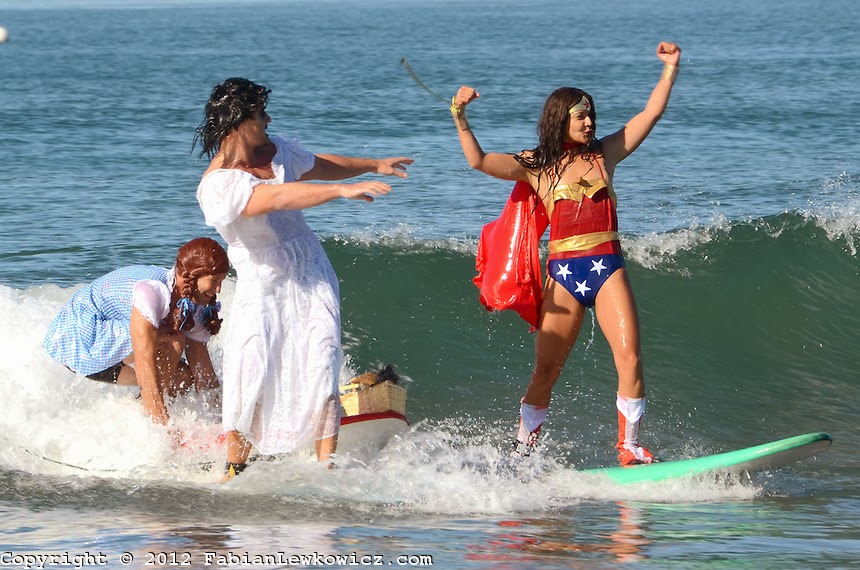
Halloween Surfers; Trick or Treat?

I love halloween... I think most surfers do. Check out these surfers having a great time out in the water...


Beyond Sight: Surfing with the Blind

I've seen this guy a few times in some surf movies / documentaries and I have to admit that this guy is really talented. It's hard enough to paddle out and catch waves when you have eyes that can see and this guy is blind charging. Check it out:


Blind Surfer Inspires In New Documentary

He was born blind, but as a new documentary coming out later this month shows, it didn't stop Derek Rabelo from taking up an unlikely sport: Surfing. At the age of 17, he decided to surf the Pipeline on the North Shore of Oahu. After meeting filmmaker Bruno Lemos at a local church, the two decided to make a documentary about the amazing feat.
"I can see the same things as others, except in different ways,” he told TransWorld Surf earlier this year.
Rabelo's legend began after Lemos posted a video of him surfing on YouTube, which became an instant viral hit. Now his story will be told with the help of some famous names in surfing: Kelly Slater, Tom Curren, Laird Hamilton, Rob Machado, Damien Hobgood, Makua Rothman, Lakey Peterson, and Coco Ho, according to thedocumentary's website. 

Blind Surfer Surfs Pipeline | Beyond Sight: The Derek Rabelo Story

Published on Jul 31, 2013
Derek Rabelo's father prayed that his son would be a professional surfer. But Derek was born blind in 1992, and his father's dream seemed impossible. Seventeen years later, however, Derek decided that not only did he want to surf -- he wanted to surf the legendary waves on the North Shore of Oahu. Derek's courage both in and out of the water shows that the best journeys in life are guided by faith, and not by sight.

Producer/Director: Bryan Jennings

Visit Grantland: http://www.Grantland.com
Grantland on Twitter: http://www.Twitter.com/Grantland33
Grantland on Facebook: http://www.facebook.com/Grantland33
The B.S. Report Podcast: http://espn.go.com/espnradio/podcast/...
Grantland Network Podcasts: http://www.grantland.com/podcasts


Monday, October 28, 2013

The Balinese Sludge Pit and Other Trashy Posts


The Balinese Sludge Pit

posted by  / News / October 16, 2013

Bali's trash epidemic.
As I walked down the steps that lead into the Uluwatu cave, my friend Brook turned and asked if I want to go to a place where most tourists don’t get to see. We hooked a sharp left off the path and less than a minute later, I was disgusted. Here, in the heart of beautiful Bali, was a bubbling swamp of black sludge. The smell of human shit made me gag. The low hum of mosquito nesting grounds made me worry. The dreamy blue tubes only a few meters below the black swamp made me realize what a surreal juxtaposition this was.
The septic pipes that are meant to treat restaurant cooking oil and toilet waste at Uluwatu are broken and the waste now flows directly into the swamp. During the rainy season, the swamp becomes a dirty waterfall that, just like the warnings on storm drains state, “Flows To The Ocean.”
I was in Bali to make a mini-documentary about the waste epidemic. It wasn’t a coincidence that we arrived at the scene I just described. After seeing the sludge pit, I interviewed the head of Project Clean Uluwatu. PCU is an organization that is working to install a liquid waste processor that would take the waste from the sludge pit and treat it properly. This is a $50,000 project and they are $20,000 shy of making it a reality. It is baffling that only $20,000 would make the difference between surfing in clean water as opposed to feces-filled scuzz at one of the most legendary waves in the world.
We don’t all need to roll up our sleeves and get messy in order for a change like this to occur. While that’s an earnest thought, it isn’t a necessity. All we really need to do is support the people who are in the trenches willing to do the work. Organizations like Project Clean Uluwatu are the architects working to fix a broken system. They are willing to do the dirty work for the rest of us. Only we need to give them the financial support to make it happen. If you’ve ever surfed Uluwatu, if you want to surf Uluwatu, if you like the ocean, if you wish something good would happen, then click here to donate, and this sludge pit could be gone by the end of the year. —Kyle Thiermann

Trash Pick Up By TSJ (www.surfersjournal.com)
Machine
Plastic in our seas, Texas-sized islands of refuse in steady rotation in the oceans' five gyres. The problem's become synonymous with the planet's unsolvable environmental decay.
But then "unsolvable" is a pretty strong word, especially for a 19-year-old. Enter Boyan Slat. Not exactly a surfer per say, Slat's a Dutch engineering student by trade, he's also the inventor of a device he calls the "Ocean Cleanup Array," an ocean-powered sifter that he claims can remove 7.25 million tons of plastic over a five-year span.
"The essence of The Ocean Cleanup Array is, instead of fighting it, to use the ocean to your advantage," reads a description on Slat's website. "The gyres are 5 areas in world's oceans where rotating currents create an accumulating mass of plastic, dubbed 'Garbage Patches'. Moving through the oceans to collect plastic would be costly, clumsy and polluting, so why not let the rotating currents transport the debris to you? With The Ocean Cleanup Array, an anchored network of floating booms and processing platforms will span the radius of such a gyre. These booms act as giant 'funnels', where a slight angle of the booms create a component of the surface current force in the direction of the platforms. The debris then enters the platforms, where it will be separated from plankton, filtered out of the water, and eventually stored in containers until collected for sales/recycling on land."
machine
Ultimately money talks, and Slat predicts by gathering the debris for recycling the project could ultimately be revenue generating.
"According to current estimations – due to the plan’s unprecedented efficiency – recycling benefits would significantly outweigh the costs of executing the project," says Slat. "Although the quality of the plastic is somewhat lower than ordinary recycled plastic, it could for example be mixed with other plastics to produce high-quality products. PR through an Ocean Plastics brand can further increase the plastics’ value, and would create awareness with the consumer."
The Ocean Cleanup Array concept began as a school paper that Slat was working on. It's since won the Best Technical Design award from Delft University of Technology. In the last year Slat also founded The Ocean Cleanup Foundation to help move the project forward. (read more at http://www.surfersjournal.com/journal_entry/trash-pick)


Surfing For Change: Indonesia Trash Tubes


Published on Sep 23, 2013
https://www.facebook.com/surfingforch...

Bali is a little island with a big problem - it's drowning in trash. In this short film, host & pro-surfer, Kyle Thiermann, shows the good, the bad, and the ugly of Indonesia and what we can do to restore it to the pristine, tropical paradise it once was.

Get more meaningful entertainment at:http://www.surfingforchange.com.

Good orgs to connect with:

http://www.projectcleanuluwatu.com
http://www.savethewaves.org
http://www.no-burn.org
http://www.travelersagainstplastic.org